SWT10 - Burners and Booms
SWT10 - Burners and Booms Summary
-
Here’s a summarized version of the video “SWT5 - Oil and Gas Manifolds” based on the transcript, in 5–10 bullet points with timestamps:
- (00:00 – 00:37) Burners are used in well testing to burn off oil at the surface, avoiding storage and pollution. They are mounted on long booms to reduce heat radiation on the rig. .
- (00:37 – 01:13) Burners atomize well effluent into fine droplets for efficient combustion. They require propane, electricity, air (from dedicated compressors), and water for heat control..
- (01:13 – 02:35) Burners include features like atomizers, water rings, pilot lights, ball/check valves, and swivels allowing positioning up to 75° from the horizontal axis..
- (02:35 – 03:14) Dedicated air compressors are essential for safety—never use rig air. Check valves protect both air and oil circuits during burner startup..
-
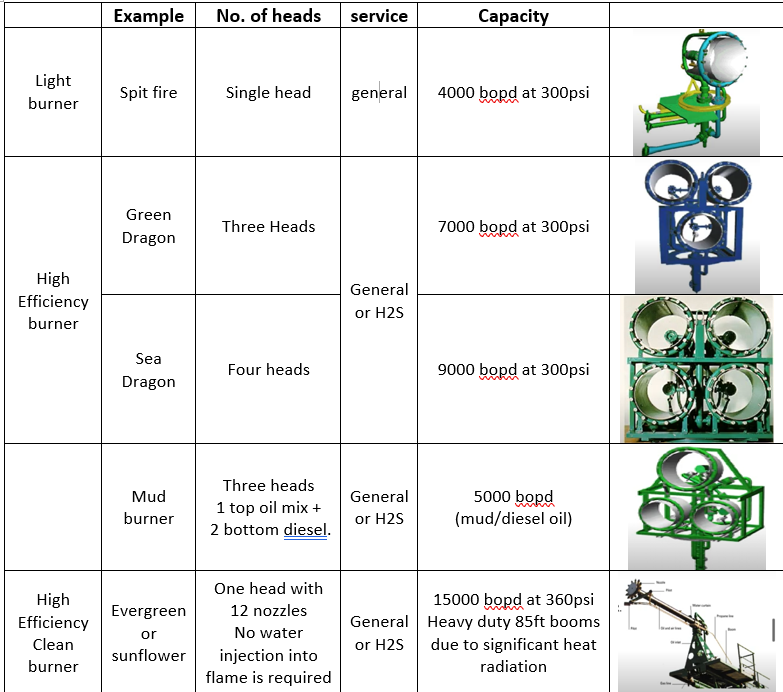
(03:14 – 04:55) Several burner types exist:
- Spitfire: Single head, 4,000 BOPD @ 300 PSI
- Green Dragon: Three heads, 7,000 BOPD
- Sea Dragon: Four heads, 9,000 BOPD
- Mud Burner: Three heads for oil/diesel mix
- Evergreen/Sunflower: Cleanest, 15,000 BOPD @ 360 PSI (requires 85-ft boom)
- (04:55 – 05:39) Booms support burners away from the rig using water curtains and pipes for air, water, oil, and propane. Two booms are installed on opposite rig sides for wind safety..
-
(05:39 – 06:20) Boom types:
- 60-ft boom: For ≤10,000 BOPD
- 85-ft boom: For >10,000 BOPD
- U-shaped: One gas flare line
- V-shaped: Two gas flare lines
- (06:20 – 07:48) Boom rig-up includes lifting by crane, securing with pins and guy lines, and aligning attachment points. Incorrect geometry poses collapse risks..
-
(08:26 – End) Safety guidelines:
- Use radio contact and daylight
- Work permit required
- Life vests mandatory, max two people on boom
- Harnesses not required but optional
Burners and Booms:
-
Burners are used to
-
Burners are used to
- dispose the oil at surface during a well-test operation
- avoid oil storage and pollution problems
- limit heat radiation on rigs
- burners are installed on long booms to keep them at a safe distance from the rig and to keep it away from the rig in order to reduce heat radiation and the risk of fire.
-
principle
- atomization of well effluent result in reduction in fine droplets
-
needs
- propane for pilots
- Electricity for lodge boxes (spark plug).
- Air compressor (do not use rig air )
- Water mainly to prevent heat radiation
Combustion achieved with atomizers, Air and oil are combined before ignition by pilots
- nozzle combination (11mm for oil - 22mm for air).
-
Burner features
- Water ringfor better combustion
- Hearth to guide the air
- Pilot lightto light the burner
- Ball valveson air and oil lines to select the number of head to be used
- Air and oilcheck valvesto prevent air from passing into the oil and vice versa (It is mounted upstream of oil and air atomizer)
- Swivel jointto allow pivoting position of the burner up to 75 degrees on either side of the horizontal axis
-
The gas pilot light is
- located below the atomizer
- small propane burner with spark plug
- lit by sending high voltage from a remote-control box (lodge box)
-
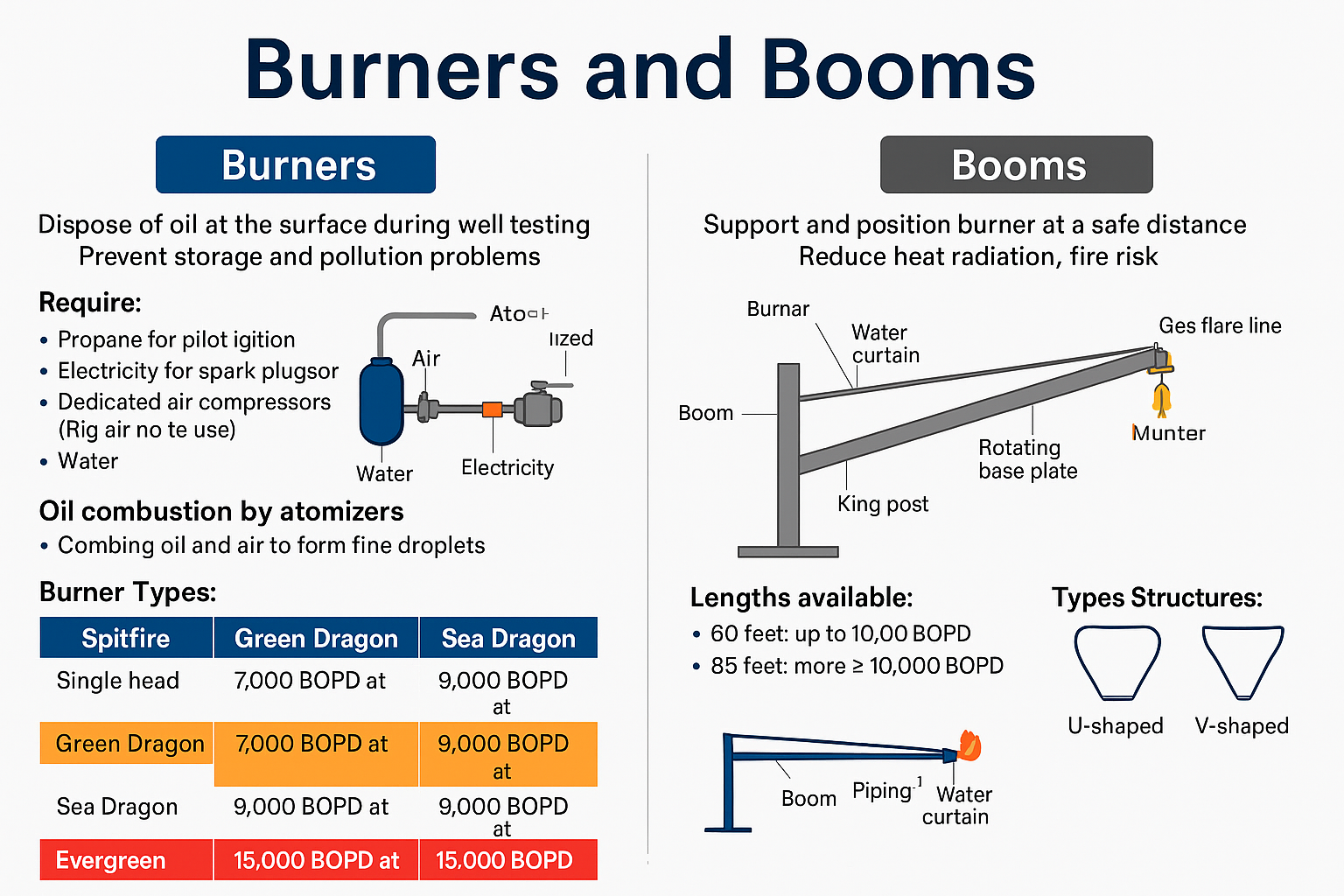
Booms
- Heat radiation also controlled with water curtains on booms.
- The boom provides gas flare pipe and piping to supply air, water, oil and propane
- Two booms are usually installed on opposite sides of a drilling rig for safe burning in changing winds
-
Lengths
- 60 feet boom up to 10000 bopd.
- 85 feet boom for more than 10000 bopd.
-
Structure
- U-shaped boom has one gas flare line.
- V-shaped boom has two gas flare lines.
-
Equipment required for installation
- King post .
- Rotating Base plate to allow horizontal and vertical movements..
- Vertical guy line fixed to king post or rig structure, support the boom.
- Horizontal guy lines orient boom horizontally.
-
Booms
Q&A Summary
-
🔥 Burners – Questions & Answers:
-
Q1: What is the main purpose of using burners during well testing?
Answer: ✅ A: Burners are used to dispose of oil at the surface during well testing, preventing storage and environmental pollution..
-
Q2: Why are burners mounted on long booms?
Answer: ✅ A: To reduce heat radiation and keep the burner at a safe distance from the rig..
-
Q3: What systems do burners require to function?
Answer: ✅
- Propane for pilot ignition
- Electricity for spark plugs or lodge boxes
- Dedicated air compressors (not rig air)
- Water to prevent excessive heat radiation
-
Q4: How is oil combustion achieved in burners?
Answer: ✅ A: Through atomizers that mix air and oil into fine droplets before being ignited by the pilot flame..
-
Q5: What are the common safety features in burner systems?
Answer: ✅
- Check valves on air and oil lines
- Swivel joints for positioning
- Water rings for efficient combustion
- Spark-ignited propane pilot lights
-
Q6: What is the role of the boom in burner systems?
Answer: ✅A: To support and position the burner at a safe distance from the rig, reduce fire risk, and carry supply lines (air, water, oil, propane)..
-
Q7: What lengths are available for booms, and when are they used?
Answer: ✅
- 60 feet: Up to 10,000 BOPD
- 85 feet: More than 10,000 BOPD (used with high heat burners like Evergreen)
-
Q8: What are the two main types of boom structures?
Answer: ✅
- U-shaped: With one gas flare line
- V-shaped (heavy-duty): With two gas flare lines
-
Q9: What components are needed to rig up a boom?
Answer: ✅
- King post
- Base plate
- Horizontal and vertical guy lines
- Swivel for boom movement
- Crane for lifting
- Safety pins and tag lines
-
Q10: What are the key safety measures during burner and boom operations?
Answer: ✅
- Work permits must be in place
- Use of life vests (not necessarily safety harnesses)
- Limit of two personnel on boom
- Preferably done in daylight with standby boat and radio communication
- Check weather conditions before operation
-
Q11: What is the maximum number of people allowed on the boom during operations?
Answer: ✅ A: Only two personnel are allowed on the boom at any time for safety reasons..
-
Q12: What is the purpose of using a water curtain on the boom?
Answer: ✅ A: To control heat radiation and enhance combustion efficiency.
-
Q13: What is the purpose of the check valves in the burner system?
Answer: ✅ A: To prevent backflow of air into the oil line and vice versa, ensuring safe operation.
-
Q14: What is the function of the pilot light in the burner system?
Answer: ✅ A: To ignite the oil and air mixture for combustion.
-
🚀 Booms – Questions & Answers
course Exam
Finaly you are in the last step of achieving your Goal✅ Important Notes Before You Start the Exam
📌 Please read these carefully before pressing the “Start Exam” button:- 🧘♂️ Take a deep breath and stay calm – This exam is about understanding, not just memorizing.
- ⏰ Make sure you're in a quiet, distraction-free space – Turn off notifications and focus.
- 🔌 Ensure a stable internet connection – Losing connection may end your exam session.
- 📝 Have everything you need ready – Paper, pen, calculator (if allowed), or any permitted tools.
- 🚫 No cheating or switching tabs – Some exams monitor your activity for fairness.
- 🧠 Read each question carefully – Don’t rush. Understand before you answer.
- 🎯 Only click the button when you're 100% ready – The exam timer will start immediately.
⚠️ Note:
Leaving the page or refreshing the browser may result in automatic submission or loss of progress.🚀 Ready to begin?
Click the button below to start your exam. Good luck! 💪