The wellhead is a critical component of an oil or gas well, and it serves as the interface between the wellbore and the surface equipment. It's located at the top of the well casing or tubing, and its primary functions are containment, control, and monitoring of fluids and pressures in the well. Here are the key elements and functions of a wellhead:
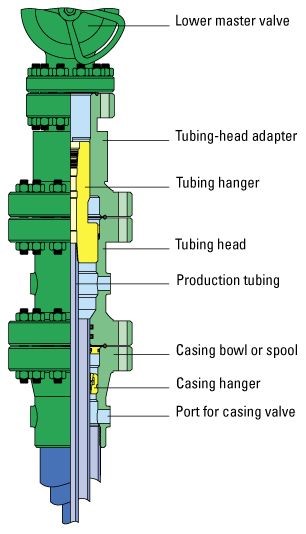
1. Pressure Containment: The wellhead provides a pressure-tight seal to prevent the escape of reservoir fluids (oil, gas, or water) from the wellbore. It contains the high pressures found deep within the well.
2. Connection Point: The wellhead serves as a connection point for various surface equipment, including production tubing, casing, control valves, and flowlines.
3. Control Valves: Control valves, such as chokes and safety valves, are often integrated into the wellhead to manage and control the flow of fluids from the well. These valves regulate pressure and flow rates.
4. Monitoring Points: Pressure and temperature sensors are typically installed on the wellhead to continuously monitor downhole conditions. This data is crucial for well control and optimization.
5. Safety Measures: Wellheads may include safety features like blowout preventers (BOPs) to prevent uncontrolled releases of hydrocarbons, especially during drilling, completion, and well testing operations.
7. Tubing Hanger: In wells with tubing strings (common in production wells), a tubing hanger supports the tubing and provides a seal to prevent fluid escape.
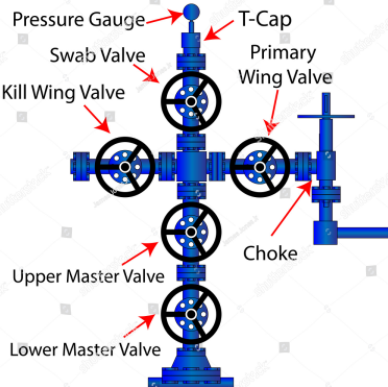
8. Production Tree: In many cases, a production tree is installed on top of the wellhead. It's a set of valves and fittings used to control the flow of hydrocarbons from the well to the production facilities or pipelines.
6. Casing Hanger: The casing hanger is a component of the wellhead that supports the casing and provides a seal between the casing and the wellhead. It helps maintain well integrity.
6. Casing Hanger: The casing hanger is a component of the wellhead that supports the casing and provides a seal between the casing and the wellhead. It helps maintain well integrity.
9. Fluid Separation: In some wells, particularly those producing water along with oil and gas, a separation system may be integrated into the wellhead to separate and collect different phases (oil, gas, water) before they are transported.
Wellheads are designed to withstand high pressures, corrosive environments, and extreme temperatures. They are a crucial part of ensuring safe and efficient oil and gas production operations. The specific design and components of a wellhead can vary depending on the well's purpose, depth, and the characteristics of the reservoir.
read more....
What are the types of x-mas trees?
a production tree, also known as a Christmas tree, is an assembly of valves, spools,
and fittings used for controlling the flow of oil or gas from a well. The type of production tree
used depends on factors such as well conditions, production requirements, and safety considerations.
Here are some common types of production trees:
Conventional Christmas Tree: This is a standard configuration used for most conventional wells. It includes valves for controlling the flow of oil or gas, as well as other components such as a choke, master valve, wing valve, and pressure gauges.
Dual Tubing Christmas Tree: In wells with dual tubing strings (two separate tubing strings for production), a dual tubing Christmas tree is used. It allows for independent control of each tubing string.
Through Tubing Christmas Tree: This type of tree is designed to accommodate through-tubing operations, where tools or instruments are run through the tubing string without the need to pull the tubing.
Horizontal Christmas Tree: For wells with horizontal completions, a horizontal Christmas tree is used. It is designed to handle the challenges posed by horizontal wells, such as controlling flow from multiple zones.
Dual Completion Christmas Tree: In wells with multiple reservoirs, a dual completion Christmas tree is employed. It allows for the independent control of each completion zone.
Vertical Subsea Christmas Tree: Subsea Christmas trees are installed on the seafloor for offshore wells. A vertical subsea tree is suitable for vertical well completions.
Horizontal Subsea Christmas Tree: This type is designed for subsea completions in horizontal wells. It provides the necessary control for horizontal well configurations.
ESP (Electric Submersible Pump) Christmas Tree: In wells that use electric submersible pumps for artificial lift, a specialized ESP Christmas tree is used to accommodate the pump and control its operation.
Slimhole Christmas Tree: Slimhole trees are designed for wells with smaller diameters. They are often used in slimhole drilling and completion operations.
Smart Christmas Tree: Some modern trees are equipped with smart technologies, such as sensors and communication systems, to enable real-time monitoring and control of well parameters.
The selection of the production tree depends on the well's characteristics, the type of reservoir,
and the production strategy. Each type of tree is designed to meet specific operational requirements
and ensure the safe and efficient production of hydrocarbons from the well.
read more....
What are types of downhole vlaves?
DHSV:D:own
H:ole
S:afety
V:alve
TRSVTubing
Retrievable
Safety
Valve
DHIV:Down
Hole
Injectivity
Valve
The selection of the production tree depends on the well's characteristics, the type of reservoir,
and the production strategy. Each type of tree is designed to meet specific operational requirements
and ensure the safe and efficient production of hydrocarbons from the well.
read more....
Flowhead
Flowhead is a temporary Christmas tree, it is located on top of the well, it it the first piece of equipment at the surface that fluids flow through.
flowhead applications:-
pre-completion testing
Drill Stem Testing
post-completion testing
flowhead features and benefits:-
that allows isolation of the surface equipment from the downhole test string.
Swab valve:that permits introduction and retrieval of wireline and slickline tools.
flowline valve:allows fluid to flow from the well. this valve is usaully operated by hydraulic actuator for ESD.
kill line valve:used to pump fluid into the well -pumping acid to clean the wellbore and to increase porosity and permeability of the formation-
swivel:allows the test string suspendend from the flowhwad to be rotated independently of the main flowhead block.
elevator sub:used to handle the flowhead with the rig elevator
threaded connection:is located on top of the elevator sub which is used to attach pressure equipment.
read more....
Tower
on the tower we have:-
suddle tank =>is a container contains hydraulic oil for coolling the lines.
Riser =>
Scrubber =>
panel =>
read more....
Christmas tree (X-mas tree/surface tree / production tree)